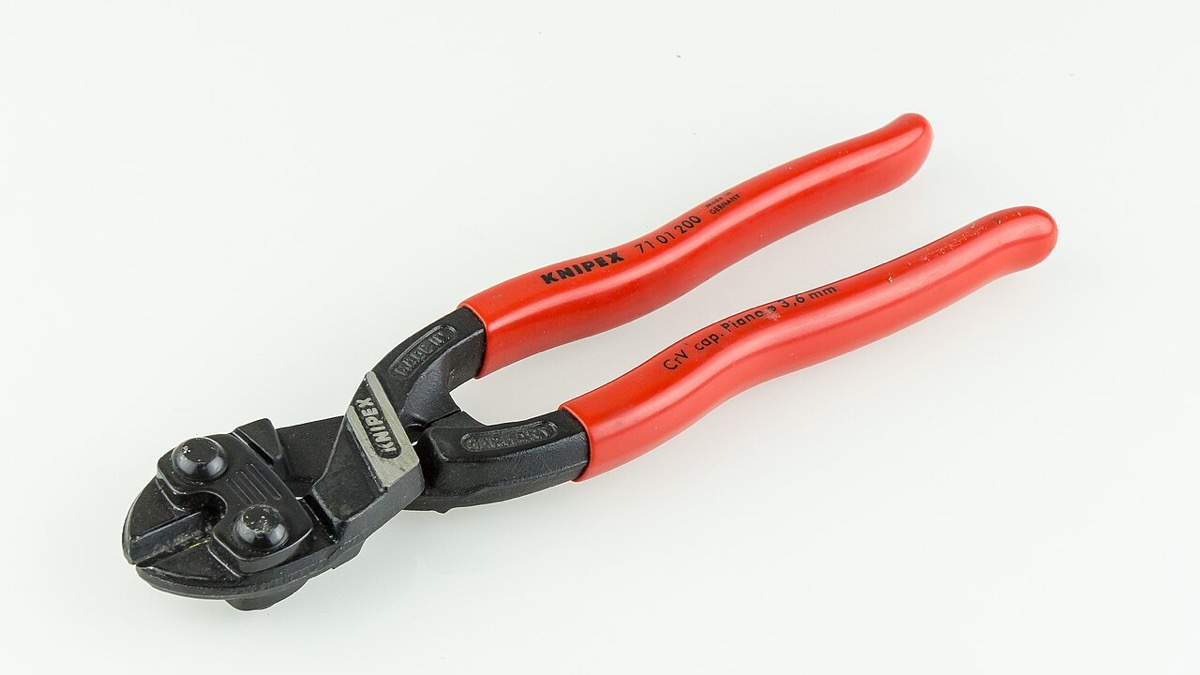
KNIPEX CoBolt 71 01 200 Compact Bolt Cutter (8 in.)
An 8-inch bolt cutter that fits a tool bag: KNIPEX rates it for soft wire up to 6 mm, hard wire up to 4 mm and piano wire up to 3.6 mm.
Quick verdict
- Best for:
- Bolts, nails and hard wire up to ~6 mm.
- Watch out:
- Many CoBolt versions; check 71 01 200.
Amazon US listing and availability checked October 26, 2026. Prices and stock can change.
Reviewed October 18, 2026 · How we review
Part of our buying guide: Hand Tool Gifts: How to Pick One They'll Use, Not One They Already Own
Our Take
The CoBolt does the jobs people usually drag out a long bolt cutter for, in a tool the size of ordinary pliers. KNIPEX says its lever joint multiplies your hand force about 35 times, and rates the 71 01 200 for soft wire up to 6 mm, medium-hard wire and bolts, nails or rivets up to 5.2 mm, hard wire up to 4 mm and piano wire up to 3.6 mm. The cutting edges are induction-hardened to about 64 HRC, and KNIPEX adds a fine texture on the edges so round stock doesn't slip out of the jaws. There's also a flat gripping surface below the joint for pulling wire or levering out a bent nail. It's 200 mm long and weighs 335 g, so it lives in a tool bag rather than the back of a truck. The limits are the ones KNIPEX states: past about 6 mm, or on hardened padlock shackles thicker than the hard-wire rating, you need a full-size bolt cutter. We haven't tested it ourselves.
Specs (This Configuration)
- Length
- 200 mm / 8 in. (KNIPEX)
- Weight
- 335 g (KNIPEX)
- Cuts
- Soft wire 6 mm; medium-hard 5.2 mm; hard 4 mm; piano wire 3.6 mm (KNIPEX)
- Edges
- Induction-hardened, about 64 HRC (KNIPEX)
- Handles
- Plastic-coated (KNIPEX part 71 01 200)
Best For
- Cutting bolts, nails, rivets and fencing wire
- Electricians, fencing and farm work, and car repairs
- Anyone who wants bolt-cutter force in a tool bag
Skip If
- You cut material thicker than about 6 mm
- You mostly cut thin copper wire (diagonal cutters are enough)
- You need to cut flush against a surface (look at the angled 71 41 200)
What We Like
- Cuts hard and piano wire that ruins ordinary cutters
- Pliers-sized, at 335 g
- Gripping surface for pulling wire and nails
What To Know
- KNIPEX sells many CoBolt versions (different heads, grips and lengths); check the part number 71 01 200
- The Amazon rating is shared with the 6-inch and 10-inch versions
- KNIPEX's product page lists no warranty terms
Pros
- 4.8 stars across the CoBolt listings we checked
- Amazon.com among the new offers on the listing
- Made in Germany (KNIPEX)
Cons
- Capacity stops at about 6 mm
- Plastic-coated handles are simpler than the multi-component grips
- Too coarse for fine electronics wire
Alternatives
- KNIPEX CoBolt S 71 01 160 — A 160 mm version that fits a pocket, with lower capacity (KNIPEX rates hard wire up to 3.2 mm).View on Amazon
- KNIPEX CoBolt XL 71 01 250 — A 250 mm version with longer handles and straight edges, for slightly thicker medium-hard wire (5.6 mm).View on Amazon
- KNIPEX Pliers Wrench 86 03 180 — Not a cutter: KNIPEX's parallel-jaw wrench for nuts and fittings, if gripping is the job.
Why PriceDropIQ Selected It
When ordinary wire cutters chip on hard wire or a stubborn bolt, the CoBolt cuts it without a long bolt cutter. It's for tradespeople, farm and fencing work, and anyone who keeps one bag of tools for everything. Choose the smaller CoBolt S for pocket carry, or the XL for more leverage; and if you regularly cut anything thicker than about 6 mm, get a full-size bolt cutter instead.
Before You Buy
- Check the part number: 71 01 200 (8 in., plastic-coated handles)
- Check the seller; Amazon.com is among the new offers
- Compare your material with KNIPEX's cutting capacities
Frequently Asked Questions
Can it cut a padlock?
Only if the shackle is within its rating. KNIPEX rates it for hard wire up to 4 mm and soft material up to 6 mm. A hardened or thicker shackle needs a full-size bolt cutter.
What's the difference between the 71 01 200 and 71 02 200?
The grips. KNIPEX lists the same 200 mm length and cutting capacities; the 71 01 200 has plastic-coated handles and the 71 02 200 has multi-component grips.
Is the 10-inch CoBolt XL worth it?
If you want more leverage and cut flat material. KNIPEX gives the XL 71 01 250 straight cutting edges and rates it for medium-hard wire up to 5.6 mm, at 465 g.
Related Buying Guides
More in Tools
All Tools reviews and guides
Interested in this product?
Reviewed October 18, 2026. Check the current offer, seller, availability, and shipping details on Amazon.
Independent buying advice, in your inbox.
New reviews and practical buying guides from PriceDropIQ.
Product photo by Raimond Spekking (CC BY-SA 4.0). Full image credit